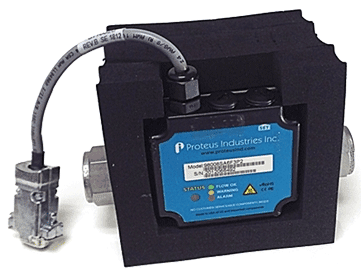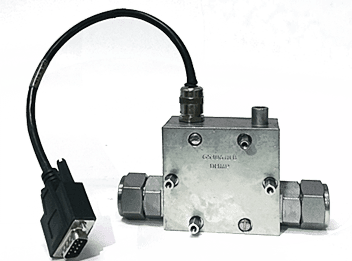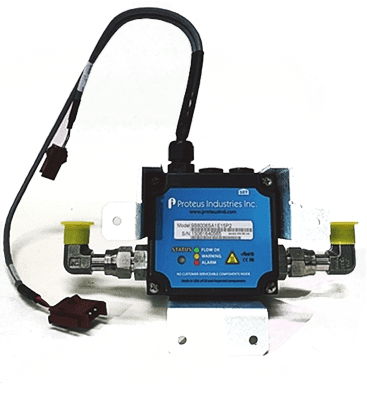
One of the most common issues that we have dealt with over the years is the use of tube fittings in calibrated flow meters. In many flow sensing applications, if the inner diameter of a fitting is smaller than the flow orifice of the flow meter, the velocity of the fluid is faster than what the meter may have been calibrated for. This is because all meters with NPT thread are calibrated using pipe whose ID (inside diameter) is greater than that of the flow orifice. For example, if a customer chooses our model 8004SN4 with a flow rate of 0.3-4.5 GPM, the flow orifice is 0.27 inches. If the customer were to use a typical swage type male connector tube fitting, ¼” tube x ¼” NPT, the ID of the fitting is 0.19 inches. The result is that the meter will report a higher flow rate than actual. This is because the paddlewheel will be spinning at a higher velocity for the same amount of line flow due to the acceleration through the fitting. In this scenario, the best solution is to use 3/8 inch tubing and the equivalent fitting which typically has an ID of 0.28 inches. With the fitting ID now larger than the flow meter orifice, the meter now conforms to its calibration.
In one case, a major semiconductor OEM was having trouble with their flow meters (not made by Proteus) failing prematurely. The flow meter manufacturer had been unable to solve the problem, and we were invited to replace them. We were told about the competitor’s failure and when we received the OEM’s specification noted that it required the use of swage tube fittings. The application went to our Applications Department for review where it was discovered that the fitting ID was smaller than the flow meter’s orifice. This was the cause of the premature failures of the competitor’s meters. The OEM shared this with them but they took no corrective action. We came up with a solution to the problem which involved a modification to the fitting. We got the business.
Another typical application is the use of 90º elbows. The elbow disrupts the laminar flow creating turbulence, which alters the profile. This changes how the flow hits the paddlewheel and affects the meter’s accuracy. In this case, the flow meter will report a flow rate less than actual. There are two possible solutions to this problem. One is to incorporate a straight run of 10 pipes inside diameters before the inlet to the flow meter. (The outlet is not critical). The other possible solution is to let us know before you purchase the product and we can arrange with you to calibrate your meter using the same type of fitting you plan to use in the application. If this is an OEM application, then we would probably propose the use of a custom part number for a meter that is configured and calibrated with the fitting already installed.
Whenever you plan to use a fitting, it is best to discuss it with our Applications Engineer after you receive your product.
If you plan to use a fitting, please contact our Applications Department. Email tech@proteusind.com or call 650-964-4163